Using the wrong vacuum in a hazardous area can be a costly mistake. A single spark could lead to disaster, but an explosion-proof vacuum1 is the safe solution.
An explosion-proof vacuum is a specialized cleaner designed to prevent ignition in environments with combustible dust or flammable vapors. It uses a brushless motor, static-dissipating components, and non-sparking materials to safely collect hazardous waste without creating a spark and causing an explosion.

I've been in this business for over 12 years, and I've seen how a simple equipment choice can have huge consequences. Choosing the right vacuum isn't just a small detail; it's a critical safety decision. Understanding what makes these vacuums different is the first step to protecting your facility and your team. Let's look closer at why this matters so much.
Why do some industries absolutely need an explosion-proof vacuum1?
Think your standard industrial vacuum is enough for any job? One wrong move in a hazardous zone could lead to disaster and massive liability. You need to know the risks.
You need one because industries like food processing, pharmaceuticals, and chemical manufacturing create combustible dust2 or vapors. A standard vacuum's motor can spark, igniting these materials and causing a devastating explosion. An explosion-proof model is built specifically to eliminate this ignition risk.
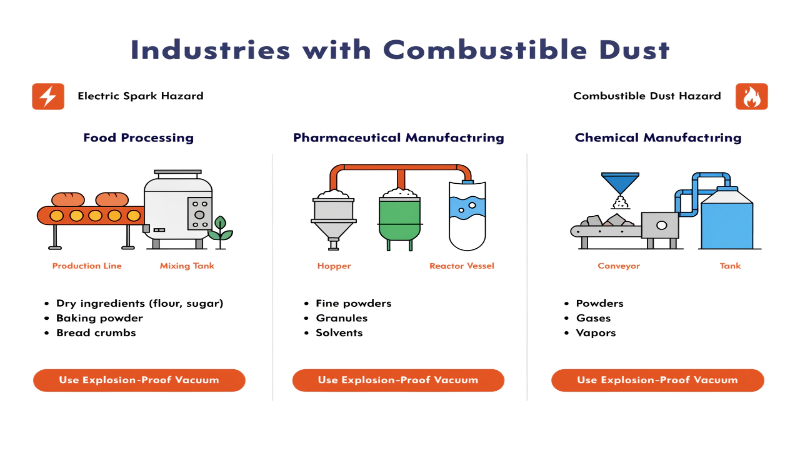
Many of my clients, especially the big brand owners I supply, are surprised to learn what counts as "combustible dust2." We're not just talking about chemicals.
Everyday materials can become highly explosive when they are in the form of a fine powder. Think about flour in a bakery, sugar in a food processing plant, or even fine metal dust in a workshop.
When this dust is suspended in the air in a confined space, all it needs is an ignition source to cause a massive explosion. This is a well-known principle in industrial safety.
A standard vacuum cleaner is a perfect ignition source. The motor has brushes that create small sparks during normal operation. That's all it takes. Explosion-proof vacuums are mandatory in these environments to comply with safety regulations like ATEX in Europe3 or NFPA standards4 in the US. It's not optional; it's a fundamental requirement for worker safety and risk management.
Industries and Their Specific Hazards
| Industry | Common Combustible Dust/Vapor |
|---|---|
| Food Processing | Flour, Sugar, Spices, Starch |
| Woodworking | Sawdust, Wood Flour |
| Metalworking | Aluminum, Magnesium, Zinc Dust |
| Pharmaceuticals | Active Pharmaceutical Ingredients (APIs) |
| Chemical Manufacturing | Plastic and Resin Powders, Flammable Vapors |
| Nuclear | Radioactive and reactive dust5 particles |
How does an explosion-proof vacuum actually prevent disasters?
Are you worried about the technical details of safety compliance? Misunderstanding how these vacuums work could lead you to choose the wrong, unsafe equipment. Let's break down the key features.
An explosion-proof vacuum1 works by eliminating all potential ignition sources. It uses a special brushless motor6 to prevent sparks, has grounded and bonded components made of non-sparking materials7, and uses conductive hoses8 and casters to dissipate any static electricity buildup safely.
When we design and manufacture these vacuums for our OEM partners, we focus on a few core principles. The goal is to remove any chance of creating a spark or a static discharge. It starts with the motor.
A regular vacuum uses a brushed motor, and those brushes create tiny arcs of electricity every second. It's a non-issue in a home, but it's a huge danger in a factory with combustible dust2. We use totally enclosed, brushless DC motors instead.
They have no internal sparking parts, which immediately removes the biggest ignition risk. Then, we look at static electricity. As dust particles and air move quickly through a plastic hose, they build up a static charge.
A discharge from that static can ignite dust. So, the entire vacuum, from the nozzle to the collection tank to the wheels, is made from conductive or static-dissipating materials. The hoses have a metal wire running through them to carry any charge safely to the ground. This ensures no static spark can ever be created.
Key Safety Features: Standard vs. Explosion-Proof
| Feature | Standard Industrial Vacuum | Explosion-Proof Vacuum |
|---|---|---|
| Motor | Brushed motor (creates sparks) | Brushless, fully enclosed motor (no sparks) |
| Construction | Standard plastics and metals | Non-sparking materials (e.g., stainless steel) |
| Static Control | No specific static control | Fully grounded with conductive hoses8/casters |
| Certification | General safety (CE, UL) | Certified for hazardous locations (ATEX, NFPA) |
What are the real risks of using the wrong vacuum in a hazardous environment?
Cutting corners on equipment might seem smart for the budget, but is it worth the risk? Using a regular vacuum for hazardous dust could cost you millions and endanger lives.
The main risk is a catastrophic explosion9, causing property damage, severe injuries, or death. Financially, it leads to massive regulatory fines, legal liability, and production downtime. A French client of mine learned this the hard way after a costly incident at a nuclear facility.
This isn't just a theoretical problem. I saw the consequences firsthand with one of my clients. He's a distributor in France, and he had a major project with a nuclear power plant in the Middle East. To try and lower the initial procurement cost10, the end-user decided to use some of our standard, high-quality industrial vacuums instead of certified explosion-proof models to handle some waste materials.
They didn't fully appreciate the reactive nature of the dust they were cleaning. During the cleanup process, a leak occurred. Luckily, it didn't trigger an explosion, but the contamination incident was a major disaster.
The regulatory fines were enormous, and the cost to decontaminate the area and deal with the production shutdown was astronomical. My client's customer lost a lot of money and faced a serious investigation.
That experience taught me a powerful lesson. Now, I tell all my clients, especially those with procurement volumes over $5 million who can't afford such a mistake: if your application involves nuclear materials, chemicals, or any combustible dust2, you must use a certified explosion-proof vacuum1. The financial and safety risks11 are simply too high to ignore.
Conclusion
Choosing the right explosion-proof vacuum1 isn't just about following rules. It's a critical decision that protects your people, your facility, and your business from catastrophic and costly disasters.
Understanding the functionality of explosion-proof vacuums is crucial for ensuring safety in environments with combustible dust or flammable vapors. ↩
Knowing which industries face risks from combustible dust can help businesses identify the need for specialized equipment like explosion-proof vacuums. ↩
Understanding ATEX certification is crucial for ensuring compliance and safety in hazardous environments, preventing costly fines and accidents. ↩
NFPA standards guide the safe design and use of equipment in hazardous environments, ensuring protection against explosions. ↩
Reactive dust can ignite easily, posing a significant danger in industrial settings, necessitating explosion-proof equipment. ↩
A brushless motor prevents sparks, making it essential for safety in hazardous environments, reducing the risk of explosions. ↩
Non-sparking materials are vital for preventing ignition sources, making them crucial for safe vacuum operation in hazardous areas. ↩
Conductive hoses safely dissipate static electricity, preventing sparks that could ignite combustible dust in hazardous areas. ↩
Understanding the risks of explosions highlights the importance of using proper equipment to prevent severe damage and loss. ↩
Balancing procurement cost with safety needs is crucial to avoid compromising safety for savings, especially in hazardous environments. ↩
Exploring these risks emphasizes the importance of investing in certified equipment to avoid costly fines and ensure safety. ↩